All posts by Panagiotis Moutis

Digital Twins of Electrical Grid Assets

January 2022

A few months ago, my work with Omid Mousavi from DEPsys SA on the Digital Twin of the Medium Voltage side of a Distribution Transformer based on Low Voltage side measurements was published in the IEEE Transactions on Power Delivery (preprint). I have been getting numerous hits on that paper plus some invitations for collaboration, so I thought I should blog a few thoughts about the subject a bit more broadly.

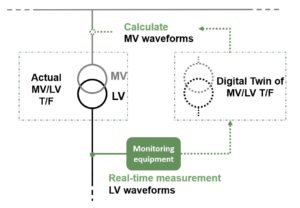
Let me start by describing the idea of this specific publication first. We want to monitor harmonics and system faults with adequate accuracy and, preferably, in real time throughout an electrical grid. However, medium and high voltage  measurement equipment is costly and might require network disruptions to be installed.  Using measurements on the lower voltage side of transformers (T/F) – LV for distribution T/F and MV for substation T/F – and relying on a model of its operation can answer both challenges, while serving the monitoring purposes. As you may read in the paper, the MV side behavior of a distribution T/F may be captured through LV measurements with the delay of a mere sample step (e.g. 0.2 ms at 5 kHz rate). Talk about real-time, right?
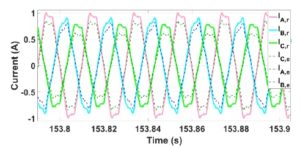
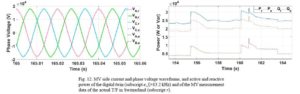
The bigger picture is that digital twins are purpose-driven. We define the needs of monitoring a phenomenon or range thereof, any challenges in the process, and engineer the infrastructure and the models required in that framework. The essence of digital twins lies in their ability to respond to real-time inputs and adjust the depiction of the asset or phenomenon in real-time, too. Some might say that they resemble a feedback control system, but for the purpose of monitoring.

The term “real-time” here though, is tricky. If the scope of the monitoring is electrical phenomena (e.g. transient faults), then the term implies sub-second detail. On the other hand, if the purpose is equipment ageing, then granularity of months might suffice. That been said, it is the subtext of real-time which is actually more important. The user or control process relying on the digital twin must be informed in-time to act upon the information. In the case of a T/F suffering an uncleared single phase fault to ground, there is a system operator or local utility that must respond and restore full operational capacity after the fault has occurred, yet fast enough. If the insulation of a breaker is nearing its replacement time, a few days (at least) of advance notice are necessary to plan maintenance actions.
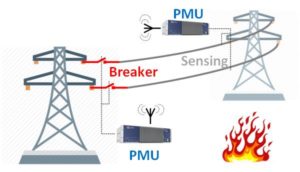
At the moment, I am considering another digital twin for overhead transmission lines that are approached by a forest fire and must get disconnected in time. Unlike, the distribution T/F digital twin, the electrical model was not sufficient for the purpose and needed to be enhanced with additional details that made it ever more challenging and interesting. Still it seems to be able to detect the forest fire in sub-second times, thus meeting the monitoring purpose. I hope to be telling you more about it soon.


Seminar at Bits & Watts (Stanford) on Machine Learning & AI for Power Systems

January 2022

I am very excited with Dr. Liang Min‘s invitation to present my Smart Grid works on power system control with machine learning and artificial intelligence in the framework of the Bits & Watts Initiative at Stanford! The seminar will take place on Feb. 24th and I will go over the use of top-down heuristically inducted binary decision trees to procure firm capacity by renewables with volatility, and on how voltage control can be modeled as a problem of classical mechanics physics. I look forward to hearing attendees’ ideas and thoughts on other machine learning and AI applications in power system optimization, planning and control.

The seminar will be in-person, so if you are faculty, student & researcher at Stanford and would like us to meet before/after the seminar, please, do not hesitate to reach out!

Seminar at Texas A&M on Active Distribution Grids

December 2021

On Friday January 28th, 2022 I will be heading out to Texas A&M to offer a seminar to the Power & Energy Group at the Dept. of Electrical & Computer Engineering. I want to thank Prof. Mladen Kezunovic for the kind invitation and Dr. Birchfield for organizing the seminar. I am excited to talk about how smart grid control and digital twins can enable distribution systems to host greater capacities of renewables, while improving customers’ service by reducing interruption times.

If you are going to be attending or are in the area and want us to talk, reach out to arrange some meeting on that day/afternoon.

Seminar at Princeton on Linear Approximations to the Optimal Power Flow

November 2021

On Thursday November 4th I had the immense honor to present one of my works at the department of Operations Research and Financial Engineering at Princeton University. Ronnie Sircar kindly invited me and I thank him deeply for that! The presentation was on one of my latest research studies about the linear approximations to the AC Optimal Power Flow and on a method to determine which approximations best fit across a given grid and a loading profile.

During my visit I had the opportunity to make new friends from multiple departments and I want to thank everyone at Princeton for their kindness and hospitality!

Seminar at NYU on Active Distribution Grids

October 2021

I am very grateful to Dr. Yury Dvorkin for honoring me with an invitation to offer an ECE seminar at the Tandon School of Engineering at NYU coming Thursday Oct. 28th! I will talk about how our interest in distribution systems has been revived and, especially, in the challenges these networks face on a daily basis. I will point out the deep-rooted technical issues that remain unresolved when operating a distribution grid and the problematic incentives that have failed to make all end-customers more active within them. The digital twin of distribution transformers for detecting grid faults and the value proposition of hybrid photovoltaic-battery systems behind the meter of residential end-customers are two of the proposals I will discuss to address the aforementioned concerns.

The seminar will be held remotely, but if you are NYU faculty, researcher or student, feel free to reach out to arrange some online meeting on that day/afternoon.

Call for Papers at CPE-POWERENG 2022, Deadline Extended to April 11th

Last updated March 2022 (originally published October 2021)

Update: The submissions deadline to the 16th IEEE International Conference on Compatibility, Power Electronics and Power Engineering (CPE-POWERENG 2022) has been extended April 11th. To submit your work follow the link found here. You can read more details about topics of interest as also about the timeliness of the subjects of the conference in the following lines.

~*~

This is an important opportunity for Submitting Papers at the 16th IEEE International Conference on Compatibility, Power Electronics and Power Engineering 2022 (IEEE CPE-POWERENG 2022), which will be held in Birmingham June 29th to July 1st, 2022.  CPE-POWERENG 2022 is sponsored by the IEEE Industrial Electronics Society. In my role as Special Sessions Chair and given the recent surge in research and funding on the subject of low inertia grids, grids with high penetrations of inverter-interfaced resources and the efforts of the IEEE and other engineering institutions in establishing standards for such resources, we established 2 Special Sessions “Future-proof power electronic systems and control for residential microgrids” and “Advances in High Switching Frequency Power Converters for E-Mobility” (read more about them here). The conference website is now open at this link and the call for papers may be found here. We are expecting submissions on:

  • Power generation, transmission and distribution
  • Power electronics and applications
  • Smart grids technologies and applications
  • Renewable energies
  • Energy storage technologies
  • Distributed power generation systems communication, security and smart metering
  • Electrical machines and adjustable speed drives
  • Transport electrification
  • Electric mobility
  • Energy market
  • EMI and EMC issue

Many thanks to Dr. Pietro Tricoli at the University of Birmingham for honoring me with the role of the Special Sessions chair at this conference. Previous IEEE CPE-POWERENG events took place in 2021, 2020 and 2019.

Seminar at Yale on Inverter Control for Grids Rich in Renewables

October 2021

I am extremely lucky to have recently met and exchanged ideas and research aspirations with Prof. Leandros Tassiulas, chair of Electrical Engineering (EE) at Yale.  He has honored me with an invitation to offer a seminar to the Dept. of EE and the Institute for Network Science at Yale on October 13th. I will be presenting 2 of my earlier research works on control methods to procure active power reserves from wind generators and string photovoltaic inverters. Even though these technologies typically pursue maximum use of their aerodynamic and solar potential, respectively, they must also be able to support system stability. This becomes even more critical as renewable resources slowly dominate the grid and displace conventional resources that have until recently ensured stability. I will extend my previous results into the most recent research aspirations for a grid dominated by inverter-interfaced renewables and batteries and how such aspirations may be made possible.

The seminar will be virtual, but I will make myself available to all faculty, students & researchers at Yale, who would like us to talk before/after the seminar, so, please, do not hesitate to reach out!

Seminar at Stevens Institute of Technology on Improving Distribution System Operation

September 2021

I am humbled by Prof. Wu‘s invitation to offer a Research Seminar at the  Dept. of Electrical and Computer Engineering at Stevens Institute of Technology on November 17th. I will be discussing the criticalities in the operation, maintenance and development of the distribution systems in electrical grids. Even though widespread black-outs are infrequent, customers in the US and elsewhere still suffer service interruptions that add up to many hours per year. The reasons lie in the poor monitoring of the distribution system, the limited use cases for distributed generation and storage in practice, and the lack of any resilience proposition. I will go over some of my recent and past works on the digital twin of distribution transformers, improving voltage profiles along feeders and actively controlling behind-the-meter photovoltaics and batteries of residential customers for improving energy costs and reducing line congestion.

The seminar will be held remotely, but I will be delighted to meet virtually with any student, researcher or faculty at Stevens for a one-on-one before or after the seminar. Feel free to reach out to arrange it!

Seminar at RPI on Power System Control with Machine Learning & Artificial Intelligence

August 2021

I want to thank Prof. Mona Mostafa Hella and Dr. Luigi Vanfretti, my friend and collaborator at the North American Synchrophasor Initiative (NASPI), for inviting me to offer a seminar at the Dept. of Electrical, Computer & Systems Engineering at the Rensselaer Polytechnic Institute on September 29th. I will review 2 of my works on generation control with machine learning (ML) and artificial intelligence (AI). I will start by discussing how to use top-down heuristically inducted binary decision trees of ML to actively control firm capacity by volatile resources operated (among others units) as a Virtual Power Plant. In the second part, I will present how voltage control can be modeled as a problem of classical mechanics physics; from there it can be solved as an AI implementation of the 2nd law of thermodynamics to redispatch active and reactive power generation. I plan to spark a discussion on conceiving new ML applications and AI models for power system operational control and monitoring.

The seminar will be virtual, but I will make myself available to all faculty, students & researchers of RPI, who would like us to talk before/after the seminar, so, please, do not hesitate to reach out!

Seminar at Ohio State University on residential PV & batteries

August 2021

I am grateful to my friend and collaborator at the IET Renewable Power Generation journal, Prof. Ramteen Sioshansi for kindly inviting me to offer a seminar at the Dept. of Integrated Systems Engineering at Ohio State University on November 10. I will talk about my earlier work at CMU on the Dept. of Energy SHINES project, on how batteries can allow residential end-customers to widely benefit from behind-the-meter photovoltaics. Reducing the costly effects of demand charges promises additional value to that of net-metering or self-consumption from photovoltaics, while the policy implications offer much food for thought on the role of utilities, cooperatives and/or microgrids.

Depending on the situation with COVID the seminar might be in-person, so follow me on Twitter & LinkedIn for updates.